
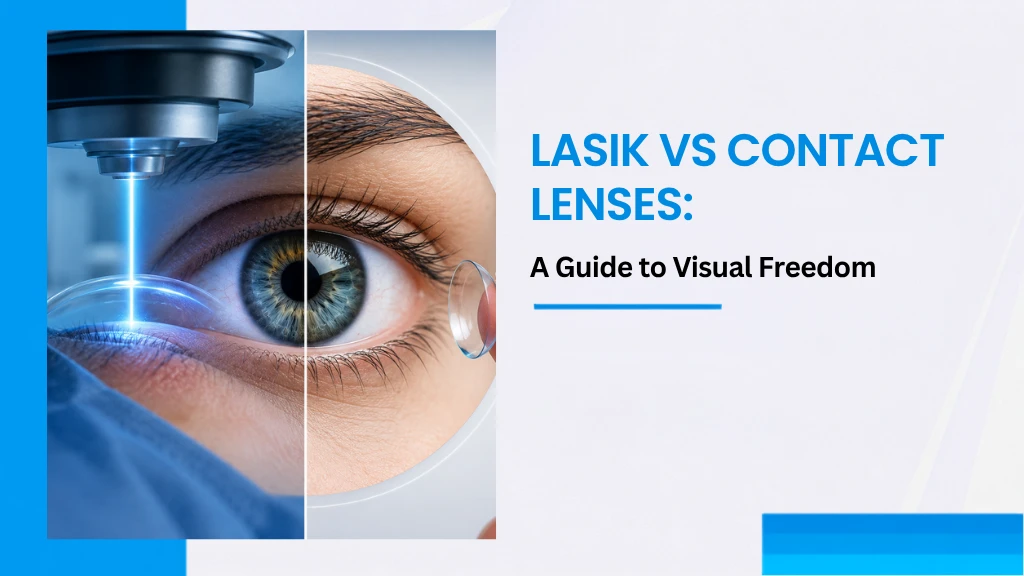
For many, the daily routine begins with a familiar but often cumbersome ritual: the search for a contact lens case or the struggle to settle a lens on a dry eye. While these temporary fixes have provided a window to the world for years, there often comes a point where the minor inconveniences, the mid-day grit, the hygiene burden, and the constant need for spares, begin to outweigh the benefits.At Dr. MM Eye Care, we believe that vision should be effortless. As a Consultant Ophthalmic Surgeon, Mr Manu Mathew specializes in helping patients move past this “daily friction” toward permanent clarity. Whether you are visiting us in Chesterfield, Derbyshire, or Leeds, our goal is to provide you with the information and reassurance you need to make the right choice for your lifestyle.
The Daily Reality: Life with Contact Lenses
When comparing LASIK vs contact lenses, the conversation usually starts with convenience but quickly shifts to ocular health. While lenses are a functional tool, they are not without their challenges:- The Dry Eye Cycle: Contact lenses can disrupt the natural tear film, leading to that gritty, “tired” feeling by late afternoon, especially for those spending long hours at a digital screen.
- Hygiene and Safety: The meticulous cleaning required is a constant mental load. Failure to maintain perfect hygiene can lead to serious complications, such as corneal ulcers or hypoxia (oxygen deprivation to the eye).
- Activity Barriers: From swimming and contact sports to the simple ease of spontaneous travel, lenses often dictate the limits of your day.
Understanding LASIK: How It Works
LASIK (Laser-Assisted In Situ Keratomileusis) is a sophisticated procedure that uses advanced laser technology to permanently reshape the cornea, the clear front part of your eye. This allows light to focus correctly on the retina, correcting common issues like myopia (short-sightedness), hyperopia (long-sightedness), and astigmatism.At our clinics, we utilize Alcon Wavelight technology and Johnson & Johnson advanced surgical systems to ensure microscopic precision. This isn’t just about “fixing” vision; it’s about tailoring the correction to the unique map of your eye.Suitability: Is LASIK Right for You?
One of the most critical steps in your journey is determining candidacy. Not every eye is suitable for laser surgery, and a consultant-led assessment is essential to ensure your safety.Who is Generally Suitable?
- Most adults over the age of 21 with a stable prescription for at least one year.
- Individuals with healthy corneas and no significant underlying eye diseases.
Who is Not Suitable? (Exclusions)
There are certain conditions where LASIK may not be the best or safest option:- Thin or Irregular Corneas: If the cornea lacks sufficient thickness, removing tissue could compromise the eye’s structural integrity.
- Severe Dry Eye: While mild dryness can often be managed, severe cases may be exacerbated by laser surgery.
- Unstable Prescriptions: Changes in your vision over the last year indicate that the eye is still changing, meaning surgery may not provide a permanent result.
- Pregnancy or Nursing: Hormonal changes can temporarily alter your prescription and corneal shape.
The Procedure: What to Expect
We understand that the idea of “lasers” and “eyes” can cause anxiety. However, the procedure is designed to be as stress-free and comfortable as possible:- Preparation: Your eyes are numbed with advanced anesthetic drops. You will remain awake but will not feel pain, only a slight pressure for a few seconds.
- Creating the Flap: A precise laser creates a thin, protective flap on the surface of the cornea.
- Reshaping: A second laser (the excimer laser) reshapes the underlying corneal tissue based on your unique prescription. This stage usually takes less than 60 seconds.
- Repositioning: The flap is gently laid back in place, where it begins to heal naturally without the need for stitches.
Clinical Balance: Risks and Limitations
As with any surgical procedure, it is vital to have a balanced understanding of the potential risks and limitations. While modern laser surgery is incredibly safe, being an informed patient is key to a successful outcome:- Temporary Dryness: Many patients experience increased dryness in the weeks following surgery. This is typically managed with prescribed lubricating drops.
- Visual Artifacts: Some individuals may experience temporary halos or glare around lights at night during the initial healing phase.
- Under or Over-Correction: In rare cases, the eye may not respond exactly as predicted, requiring a small “enhancement” procedure to achieve the final result.